What is Filet Crochet?
Filet crochet is a technique of making lace using double crocheted squares and open squares to create pictorial designs. Once you learn this technique, you can not only use filet crochet patterns, but can convert other charted needlework designs, such as cross stitch or knitting patterns, into a filet crochet pattern.
While crochet is generally believed to have originated in France (crochet comes from the French word for hook) in the 1500s, filet crochet is a newer technique. Crochet was used by women of modest means to copy the beautiful needle and bobbin laces worn by the rich. Creative needleworkers developed forms such as Irish crochet to make floral and leaf designs which were then arranged and joined by a background mesh of crocheted netting. Filet crochet makes a faster lace fabric by creating the designs and the open mesh at the same time.
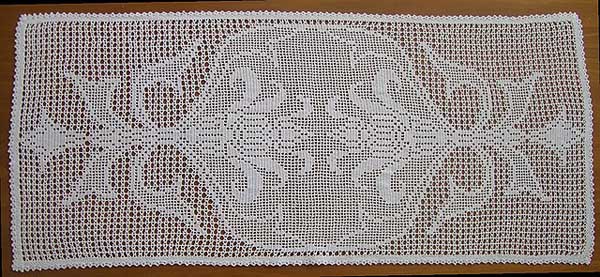 By Cgoodwin - Own work, CC BY-SA 4.0, Filet crochet. (2019, April 12). In Wikipedia.
Filet crochet as a term appeared in publications as early as 1912, although the technique was already in practice, known by the term “square crochet” for the blocks of filled and open spaces in the designs. (See McLaughlin below.) While some older patterns may give only written, line by line instructions, filet crochet is most conveniently shown in a chart with shaded and unshaded blocks to indicate solid and open mesh areas, respectively.
How to Filet Crochet
Make a foundation chain according to your pattern instructions. Next, look at the filet crochet chart. Each row of the chart represents a row of crochet. Odd numbered rows are read from right to left, while even rows are read left to right. This is to mimic the way you turn your work in crochet, alternating right and wrong sides as you work back and forth.
Every vertical line in a row is a double crochet (dc) stitch (the starting chain 3 of each row is the first dc.) Between the vertical lines, a shaded block is made of 2 dc stitches while an unshaded block is made by skipping the next 2 stitches and doing chain (ch) 2 instead. Note that some patterns will call for you to use blocks of 3 dc or 3 chains between lines, but 2 is common.
Filet Crochet Stitches
Once the pattern of blocks and mesh spaces is established, filet crochet is actually not difficult. You only need to know two stitches: chain and double crochet. Those two crochet stitches are sufficient to create the entire design.
To summarize, every block of the filet crochet pattern begins with a dc and is followed by either 2 more dc (shaded block) or ch2, skip next 2 stitches (open block.) The last stitch of each row is a dc for the final vertical line. While this might seem difficult at first, soon you will find working with the chart makes the work go quickly. After the first few rows, you will see the lace picture taking shape and everything will make sense. It really will!
Tutorials and Patterns
When learning a new technique, it can help to see videos of the stitches. Scroll down this page for links to some helpful tutorials and resources. We have also curated a collection of free filet crochet patterns for your convenience.
Filet Crochet Ideas
This modern lace technique is traditionally done in cotton crochet thread in various weights to create doilies, place mats, or tablecloths. The technique can also be used in heavier yarn to make afghans and bedspreads. In lightweight wool it can make a lovely shawl or even a wedding veil.
Try a smaller project in yarn to begin your filet crochet journey. Once you see how this block by block method works, try more detailed projects with finer yarn or thread and smaller hooks. You may find this becomes one of your favorite crochet techniques!
References:
McLaughlin, T., The Origins of Filet Crochet, https://www.interweave.com/article/crochet/the-origins-of-filet-crochet/, 2013
Thomas, M., editor, Favorite Doilies of Rita Weiss, p. 9, American School of Needlework, 1982